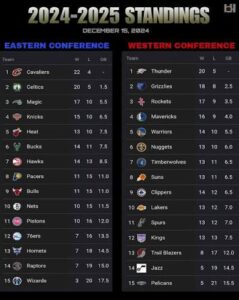
The Power and Importance of NBA Standings
In the NBA, the standings do more than just show who’s winning — they tell the story of the season. They determine playoff seedings, home-court advantages, play-in tournament eligibility, and often reflect the strategic direction of franchises. For fans, standings are a constantly evolving scoreboard of hope, frustration, and opportunity.
What the NBA Standings Represent
At their core, standings list each team’s wins (W), losses (L), win percentage (PCT), and “games back” (GB) from the top spot in a conference. But behind those simple numbers lie several nuances:
- Conference & Division Ranks: Teams are sorted first by conference (East vs. West), and within each conference by record. Divisions (such as Atlantic, Central, Southeast in the East; Northwest, Pacific, Southwest in the West) also matter — as tiebreakers sometimes refer to division record.
- Games Back (GB): Indicates how many games a team is behind the conference or division leader. If Team A is 3–1 and Team B is 1–3, Team B is 2 games back.
- Home / Away / Division / Conference Records: These breakdowns show how well a team performs in specific settings — e.g. “home court” or against its own conference.
- Streak & Last 10 Games: These give momentum context — are they on a winning streak? Are they slipping over the last ten games?
These details help fans understand not only where a team sits, but how it got there.
2024–25 Standings: Key Highlights & Takeaways
Let’s look at the recently concluded 2024–25 season’s standings (via Basketball-Reference) to draw insights.
Eastern Conferences
- Cleveland Cavaliers dominated, finishing with a 64–18 record and the top seed in the East.
- Boston Celtics followed closely at 61–21, 3 games back.
- Below them, New York Knicks, Indiana Pacers, Milwaukee Bucks, and Detroit Pistons all secured playoff berths.
- On the bubble were Orlando Magic (41–41) who just made it, while Atlanta Hawks, Chicago Bulls, and Miami Heat fell just short of solid positioning.
- The bottom tier included Toronto Raptors, Brooklyn Nets, Philadelphia 76ers, Charlotte Hornets, and Washington Wizards. Particularly, Washington finished 18–64, anchoring the East.
Western Conference
- Oklahoma City Thunder absolutely dominated with a 68–14 record — the best in the league.
- Houston Rockets stood as a distant second in the West at 52–30.
- An interesting clustering: Lakers, Nuggets, and Clippers all ended with 50–32 records (tied) — an example of how tiebreakers and point differential can determine seeding.
- Minnesota Timberwolves (49–33) and Golden State Warriors (48–34) also made it into the playoff mix.
- The rest of the West — Memphis, Sacramento, Dallas, Phoenix, Portland, San Antonio, New Orleans, Utah — were all sub-.500 teams, missing the postseason.
Why Standings Matter — Beyond Just Numbers
1. Playoff Seeding & Home Court
Finishing higher in the standings grants advantages in the playoffs. The better-seeded team usually gets home-court advantage in series. In tightly matched matchups, that edge can be decisive.
2. Play-In Tournament
In recent seasons, the NBA introduced a play-in tournament for seeds 7 through 10 in each conference. Teams that finish 7th or 8th are safer, while 9th and 10th might have to fight their way in. This means middle-of-the-pack teams fight hard in the closing weeks to improve the margin and avoid the play-in.
3. Tiebreaker Rules
When teams end with identical records, several tiebreakers kick in:
- Head-to-head record
- Division record (if same division)
- Conference record
- Point differential
- Records vs. playoff teams, etc.
That’s why every game — even midseason showdowns — can ripple into playoff seeding.
4. Momentum and Psychology
A team riding a winning streak or entering playoffs with strong finish (good “last 10 games” record) often carries confidence forward. Conversely, a team collapsing down the stretch could be psychologically vulnerable.
5. Long-Term Strategy & Roster Moves
Front offices watch standings closely. If a playoff berth seems unlikely midseason, some teams may start developing younger players or trade veterans for future assets. Improving standings can also affect draft pick protections, trade leverage, and fan engagement.
Interpreting Standings — What They Reveal
Let’s highlight a few lessons from the 2024–25 standings:
- Dominance vs Depth: OKC’s 68–14 run underscores how a dominant top seed often combines star performance with depth and consistency.
- Tight Races: The tie at 50–32 among Lakers, Nuggets, and Clippers illustrates how competitive balance in the West pushes teams to fight for every win.
- Bubble Drama: On the East, teams like the Magic, Hawks, and Heat battled for positioning in the lower playoff slots — showcasing how mid-tier games matter.
- Bottom of the Barrel: Washington’s 18–64 season is a reminder that rebuilding phases yield low standings, but also high draft positioning.
- Home Court Advantage: Many top teams had strong home records, which often translated into fewer losses at home and more dominance. The home/away splits show how some teams build “fortress arenas.”
How to Write a Standings Blog That Engages
If you’re turning this into a blog article, here are tips to make your standings coverage more compelling:
- Visuals & Tables
Embed up-to-date standings tables (conference, division) with color coding (playoff, play-in, out). - Highlight Storylines
Don’t just list numbers — tell narratives. E.g., “Cleveland emerged from obscurity to lead the East,” or “Oklahoma City’s point differential crushed the rest of the league.” - Use Graphs & Trends
Show graphs of “Wins over time,” “Streak charts,” or “Standings change week by week.” - Explain the Jargon
Make sure your audience understands terms like “games back,” “tiebreakers,” “play-in,” etc. - Tie to Player and Team Moves
If a team trades a star midseason, mention how that impacted standings. - Forecast Implications
Use standings to predict potential playoff matchups, upsets, or home-court battles. - Update Regularly
Standings are dynamic — publish weekly or daily during the season to keep readers returning.
Sample Blog Structure + Suggested Headings
Here’s how you might structure your 1,000-word blog post:
- Introduction
- Why standings matter
- What fans look for
- Understanding the Columns (W, L, GB, etc.)
- Explain each key metric
- Why division and conference splits matter
- 2024–25 Recap: Standings Highlights
- Top teams in East & West
- Surprise teams / disappointments
- Lessons from the Standings
- Dominance, depth, tight races
- Bubble teams and strategies
- Why This Season’s Standings Are Particularly Interesting
- Tie clusters, rebuilding teams, tight margins
- Standings Into Playoffs: What It Means
- Seeding, home court, play-in mechanics
- How I’ll Use These in My Predictions or Coverage
- Matchups, betting, reader engagement
- Conclusion & Call to Action
- Encourage readers to watch closing games
- Promise next update
Suggested Opening (Example)
The NBA standings are more than just a scoreboard — they’re a living map of ambition, tension, and possibility. Each season, fans peer at them to see who’s rising, who’s falling, and who still has a shot at glory. In 2025, the standings told a dramatic story: a dominant Oklahoma City Thunder in the West, a tightly contested Eastern Conference, and dozens of games that carried playoff dreams or dashed them entirely.